Origin
Astragalus is a perennial in the pea family that grows on the dry grasslands of northern China. The main growing regions are Inner Mongolia, Shanxi (especially Hunyuan County, whose root is sold as 北芪 “northern qi”), Gansu and Heilongjiang.
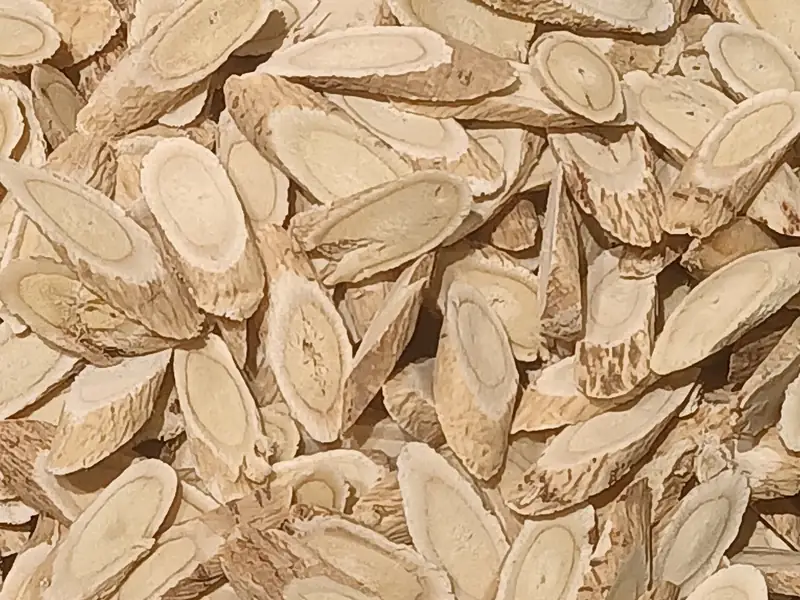
Cultivated roots are usually dug after two years; slower-grown roots take three to five years or more. They are sliced lengthwise into long, tongue-shaped pieces with a yellow centre and pale outer ring.
Traditional use
Astragalus is one of the most common herbs in Cantonese soup packs for the cooler months, simmered with chicken or pork, red dates and codonopsis. In Chinese food tradition it is classed as slightly warming.
Many Cantonese families leave astragalus out while someone has a cold or fever, and switch to lighter soups until they are well again.
Safety
- Immunosuppressant medicines: astragalus may work against medicines that suppress the immune system, such as those taken after an organ transplant. Ask your doctor first.
- Autoimmune conditions: if you have lupus, rheumatoid arthritis, multiple sclerosis or a similar condition, check with your doctor before using astragalus.
- Lithium: astragalus may affect how the body clears lithium. Ask your doctor if you take it.
- Pregnancy and breastfeeding: there isn’t enough safety information. Ask first.
- Buy the right plant: only buy astragalus sold as a food or soup herb (Astragalus mongholicus or A. membranaceus). Some other Astragalus species are toxic.
How to cook
- Use 15–20 g of slices for a 2–3 litre pot.
- Rinse, then add at the start with the meat and other dried ingredients.
- Simmer 1½–3 hours. The longer it cooks, the sweeter the soup.
- The slices stay fibrous: remove them before serving. For a simple tea, simmer 3–4 slices with 3 red dates for 20–30 minutes.
How to choose and store
Choose wide, firm slices with a yellow centre, a clear pale ring and a sweet, beany smell. Avoid slices that are very white or smell sour, which can be a sign of sulphur bleaching. Store airtight in a cool, dry place.
This page describes culinary and cultural tradition. It is not medical advice. If you are pregnant, breastfeeding, taking medication or managing a health condition, check with your doctor or a registered Chinese medicine practitioner before using herbal ingredients.
Last updated: